> ## Documentation Index
> Fetch the complete documentation index at: https://docs2.growthbook.io/llms.txt
> Use this file to discover all available pages before exploring further.
# Constants
> Define reusable values once and reference them from feature flags
Constants are reusable named values you define once in GrowthBook and reference from feature flag values. Change a constant in one place and every flag that references it picks up the new value the next time its SDK payload is built — no need to edit each flag.
Common uses:
* A shared endpoint or hostname used across many flags (e.g. an API server URL).
* A block of JSON config reused by several flags.
* Values that differ per environment (e.g. a production vs. staging URL) behind a single reference.
## Constant types
Each constant has one type:
* **String** — a plain string value (URLs, keys, identifiers, etc.).
* **JSON** — a JSON **object** (key/value map), used as a reusable config template merged via `$extends`.
## Per-environment values
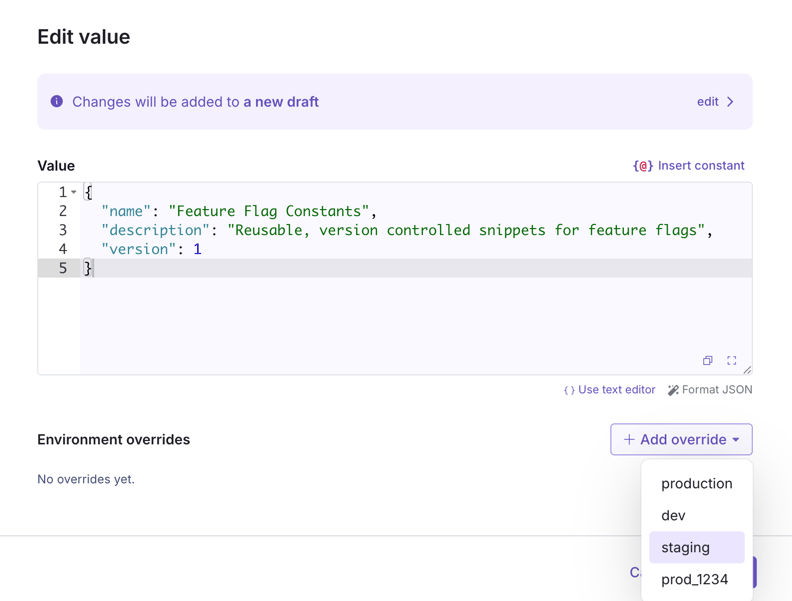
A constant has a base **value** plus optional **per-environment overrides**: when a flag is built for an environment, its override is used if set, otherwise the base value. A reference to a constant with no value for the target environment is left as-is in the payload.
 ## Referencing constants
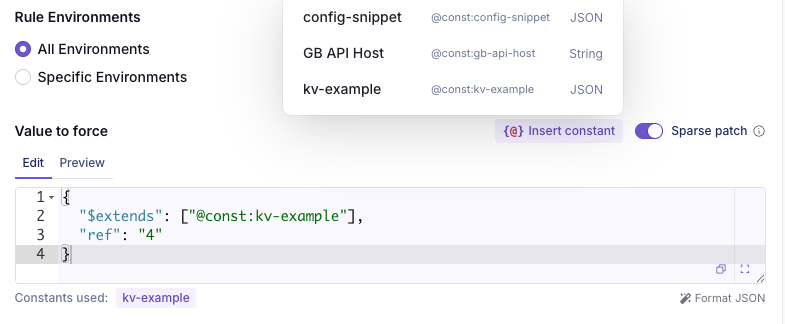
Constants are referenced by their **key** — a slug auto-generated from the name (e.g. a constant named "API Server" gets the key `api-server`). In a feature value editor, use **Insert constant** to pick one, or type the reference by hand. The reference syntax depends on the constant's type:
## Referencing constants
Constants are referenced by their **key** — a slug auto-generated from the name (e.g. a constant named "API Server" gets the key `api-server`). In a feature value editor, use **Insert constant** to pick one, or type the reference by hand. The reference syntax depends on the constant's type:
 ### String constants — `{{ @const:key }}`
Interpolate a string constant anywhere inside a feature's or a [config](/features/configs)'s string value (including inside a string field of a JSON value):
```
Connect to {{ @const:api-server }} on port {{ @const:api-port }}.
```
```json theme={null}
{
"endpoint": "{{ @const:api-server }}"
}
```
### JSON constants — `$extends`
JSON constants are objects (key/value templates). Compose them with an `$extends` array that lists one or more constant references. Each referenced object is merged in, in order, and the object's own keys override the merged result:
```json theme={null}
{
"$extends": ["@const:default-config"],
"timeout": 30
}
```
`$extends` works for a nested value too:
```json theme={null}
{
"limits": { "$extends": ["@const:default-limits"] }
}
```
Merge precedence, lowest to highest:
1. `$extends` references, in array order (later references override earlier)
2. the object's own keys
So the position of `$extends` in the object doesn't matter — own keys always win — but the order of references *within* the array does.
**Own keys replace wholesale.** A constant is an atomic building block: whatever an own key states is exactly what it resolves to. When an own key and the merged base are both objects, the own value **replaces** the inherited one outright — it is not merged into it. For example, extending a base of `{ "retry": { "connect": 1000, "read": 5000 } }` with own keys `{ "retry": { "read": 8000 } }` resolves to `{ "retry": { "read": 8000 } }` — `connect` is dropped, not inherited. Restate any inherited fields you want to keep. (Writing `null` sets the value to `null`; it does not delete the key.)
**Constants replace; configs and feature values patch**
This is deliberately the opposite of how [configs](/features/configs) and feature values compose. A child config — or a config-backed feature value — is a **deep, targeted patch**: it merges recursively, key by key, restating only the leaves it changes. A constant's own keys are authoritative wholesale. The same `$extends` syntax written directly in a feature or config value follows the deep-patch rule, not this one — the mode depends on which entity's keys they are, not on what is being extended.
A referenced chunk is always applied **whole**: an `$extends` reference (or a nested object that itself uses `$extends`) drops in as a complete unit. A constant's value can itself reference other constants; they're resolved recursively.
**Advanced: control merge order with inline objects**
An `$extends` entry can also be an **inline object** instead of a `@const:` reference. It merges at that position, so a *later* reference can override it — something own keys can't do (they always win). Most templates only need references plus own keys; reach for this only when you need a literal layer beneath a referenced one.
```json theme={null}
{ "$extends": [{ "timeout": 30 }, "@const:override-pack"] }
```
Here `@const:override-pack` can override the inline `timeout`. Loose entries that are neither a reference nor an object (numbers, booleans, bare strings) are rejected when you save.
## How resolution works
References are resolved **when the SDK payload is built**, on the server. SDKs receive the fully-resolved value, so no SDK changes or upgrades are required.
A few rules:
* **On by default.** Feature and config values are scanned for references automatically.
* **Escape literals.** To keep a literal `{{ @const:... }}` or `@const:` key in a value, wrap it in backticks.
* **Graceful failure.** An unresolvable `{{ @const:... }}` interpolation — unknown constant, type mismatch, or a cycle — is left in place as literal text rather than failing the build. An unresolvable `$extends` reference is dropped instead (a leftover directive would be invalid config).
* **Archived references are stripped.** Archiving a referenced constant is blocked (see [Editing and approvals](#editing-and-approvals)), but any reference that still points at an archived constant is removed from the value (string interpolations dropped, JSON references removed) rather than resolved.
## Protecting keys used by running experiments
If a constant feeds a [config](/features/configs) whose running-experiment guard is enabled, publishing a change to the constant is subject to that same guard: it is blocked when the change would alter a config key currently used by a running experiment or contextual bandit. The guard is computed live, so it clears on its own once the experiment stops. To publish anyway, acknowledge the block — confirm the warning in the app, or pass `"ignoreWarnings": true` in the body of the REST publish request. See [Protecting keys used by running experiments](/features/configs#protecting-keys-used-by-running-experiments) for the config-side details.
## Editing and approvals
Constant changes go through the same draft → review → publish flow as features, governed by your organization's [require-reviews settings](/features/publishing-and-approval-flows) matched on the constant's project. You can view past versions, compare revisions, and revert from the constant's page.
Archiving is blocked while a constant is still referenced — the archive dialog lists every feature and constant that uses it, so you can remove those references first.
## REST API
Constants are fully manageable over the [REST API](/api/#tag/constants) — create, update, archive, list references, and drive the revision/approval flow programmatically.
## Permissions
Creating, editing, and deleting constants requires the **Manage Constants** permission (the `ConstantsFullAccess` policy), which is included in the Engineer, Experimenter, and Admin roles by default. Constants can be scoped to specific projects.
### String constants — `{{ @const:key }}`
Interpolate a string constant anywhere inside a feature's or a [config](/features/configs)'s string value (including inside a string field of a JSON value):
```
Connect to {{ @const:api-server }} on port {{ @const:api-port }}.
```
```json theme={null}
{
"endpoint": "{{ @const:api-server }}"
}
```
### JSON constants — `$extends`
JSON constants are objects (key/value templates). Compose them with an `$extends` array that lists one or more constant references. Each referenced object is merged in, in order, and the object's own keys override the merged result:
```json theme={null}
{
"$extends": ["@const:default-config"],
"timeout": 30
}
```
`$extends` works for a nested value too:
```json theme={null}
{
"limits": { "$extends": ["@const:default-limits"] }
}
```
Merge precedence, lowest to highest:
1. `$extends` references, in array order (later references override earlier)
2. the object's own keys
So the position of `$extends` in the object doesn't matter — own keys always win — but the order of references *within* the array does.
**Own keys replace wholesale.** A constant is an atomic building block: whatever an own key states is exactly what it resolves to. When an own key and the merged base are both objects, the own value **replaces** the inherited one outright — it is not merged into it. For example, extending a base of `{ "retry": { "connect": 1000, "read": 5000 } }` with own keys `{ "retry": { "read": 8000 } }` resolves to `{ "retry": { "read": 8000 } }` — `connect` is dropped, not inherited. Restate any inherited fields you want to keep. (Writing `null` sets the value to `null`; it does not delete the key.)
**Constants replace; configs and feature values patch**
This is deliberately the opposite of how [configs](/features/configs) and feature values compose. A child config — or a config-backed feature value — is a **deep, targeted patch**: it merges recursively, key by key, restating only the leaves it changes. A constant's own keys are authoritative wholesale. The same `$extends` syntax written directly in a feature or config value follows the deep-patch rule, not this one — the mode depends on which entity's keys they are, not on what is being extended.
A referenced chunk is always applied **whole**: an `$extends` reference (or a nested object that itself uses `$extends`) drops in as a complete unit. A constant's value can itself reference other constants; they're resolved recursively.
**Advanced: control merge order with inline objects**
An `$extends` entry can also be an **inline object** instead of a `@const:` reference. It merges at that position, so a *later* reference can override it — something own keys can't do (they always win). Most templates only need references plus own keys; reach for this only when you need a literal layer beneath a referenced one.
```json theme={null}
{ "$extends": [{ "timeout": 30 }, "@const:override-pack"] }
```
Here `@const:override-pack` can override the inline `timeout`. Loose entries that are neither a reference nor an object (numbers, booleans, bare strings) are rejected when you save.
## How resolution works
References are resolved **when the SDK payload is built**, on the server. SDKs receive the fully-resolved value, so no SDK changes or upgrades are required.
A few rules:
* **On by default.** Feature and config values are scanned for references automatically.
* **Escape literals.** To keep a literal `{{ @const:... }}` or `@const:` key in a value, wrap it in backticks.
* **Graceful failure.** An unresolvable `{{ @const:... }}` interpolation — unknown constant, type mismatch, or a cycle — is left in place as literal text rather than failing the build. An unresolvable `$extends` reference is dropped instead (a leftover directive would be invalid config).
* **Archived references are stripped.** Archiving a referenced constant is blocked (see [Editing and approvals](#editing-and-approvals)), but any reference that still points at an archived constant is removed from the value (string interpolations dropped, JSON references removed) rather than resolved.
## Protecting keys used by running experiments
If a constant feeds a [config](/features/configs) whose running-experiment guard is enabled, publishing a change to the constant is subject to that same guard: it is blocked when the change would alter a config key currently used by a running experiment or contextual bandit. The guard is computed live, so it clears on its own once the experiment stops. To publish anyway, acknowledge the block — confirm the warning in the app, or pass `"ignoreWarnings": true` in the body of the REST publish request. See [Protecting keys used by running experiments](/features/configs#protecting-keys-used-by-running-experiments) for the config-side details.
## Editing and approvals
Constant changes go through the same draft → review → publish flow as features, governed by your organization's [require-reviews settings](/features/publishing-and-approval-flows) matched on the constant's project. You can view past versions, compare revisions, and revert from the constant's page.
Archiving is blocked while a constant is still referenced — the archive dialog lists every feature and constant that uses it, so you can remove those references first.
## REST API
Constants are fully manageable over the [REST API](/api/#tag/constants) — create, update, archive, list references, and drive the revision/approval flow programmatically.
## Permissions
Creating, editing, and deleting constants requires the **Manage Constants** permission (the `ConstantsFullAccess` policy), which is included in the Engineer, Experimenter, and Admin roles by default. Constants can be scoped to specific projects.